
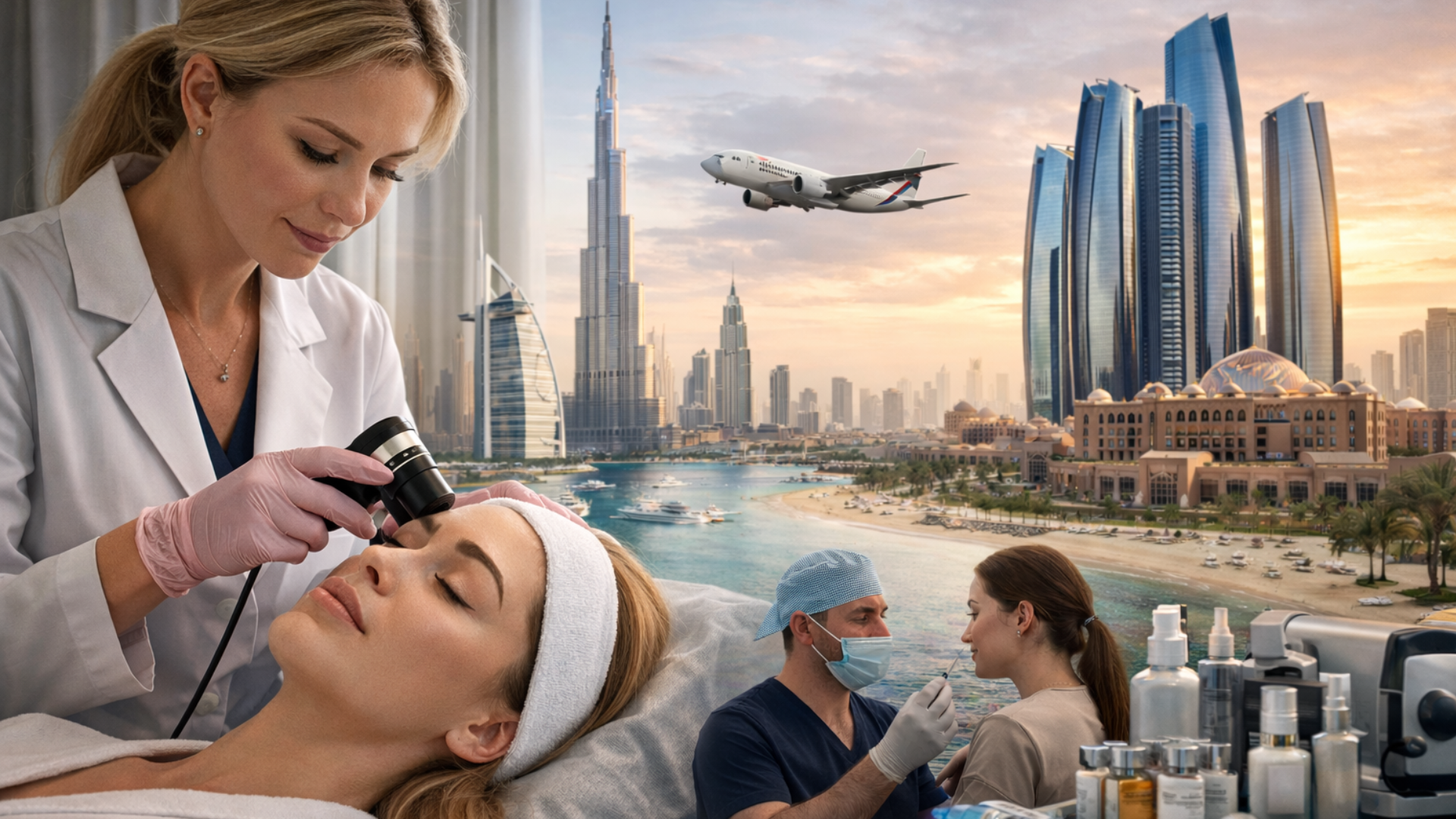
How Dubai and Abu Dhabi Are Becoming Global Destinations for Cosmetic Dermatology – And What That Means for Hiring
There is a moment when a market tips from promising to undeniable. For cosmetic dermatology in the UAE, that moment has arrived.
Dubai and Abu Dhabi are no longer simply growing as aesthetic medicine destinations. They are actively competing with London, Paris, New York, and Seoul for the title of the world’s most sophisticated cosmetic dermatology markets — and by almost every measurable metric, they are winning.
For healthcare providers, clinic operators, and hospital administrators across the UAE and GCC, this creates both an extraordinary commercial opportunity and a pressing operational challenge: the demand for qualified, Western-trained dermatologists is growing faster than the supply of licensed, practice-ready specialists. For those who understand the hiring landscape and move strategically, the rewards are significant. For those who wait, the cost of an empty dermatology chair will be measured in lost revenue, lost patients, and lost competitive ground.
This blog sets out exactly why the UAE dermatology market has reached this inflection point — and what it means for the organisations now racing to recruit the specialists to serve it.
The Numbers Tell the Story
Start with the headline figure: the UAE dermatology and aesthetic market was valued at USD 402.4 million in 2024 and is projected to grow at 10.8% annually between 2025 and 2030, reaching USD 736.5 million by 2030.
That is a market nearly doubling in size in six years — in a country the size of Portugal.
The cosmetic dermatology segment alone is experiencing robust growth, with a projected market value of AED 1 billion by 2024, driven by rising disposable incomes and a growing focus on aesthetics.
And the devices market that underpins clinical delivery reflects the same trajectory: the UAE Medical Aesthetic Devices Market is expected to reach USD 113.21 million in 2025 and grow at a CAGR of 8% to reach USD 166.34 million by 2030, driven by the growing number of aesthetic procedures and expanding medical tourism.
These are not projections built on optimism. They are projections built on infrastructure investment, government strategy, population growth, and a proven track record of patient demand that has been accelerating consistently for over a decade.
Why Dubai and Abu Dhabi — Why Now?
The confluence of factors driving the UAE’s dermatology boom is not accidental. It is the result of deliberate government strategy, demographic reality, and cultural shift intersecting at precisely the right moment.
1. Medical Tourism Is a National Priority
The UAE medical tourism market is projected to reach over USD 4.4 billion by 2033, with Dubai retaining a leading market share. The highest volume of international patients seek dentistry, dermatology, and gynaecology treatments.
This is not a marginal revenue stream — it is a core pillar of Dubai’s economic diversification strategy. The Dubai Health Authority has built dedicated infrastructure to support it: the Dubai Health Experience (DXH) online portal gives international patients access to booking appointments with healthcare professionals, hotels, transportation, visa information, and other recreational activities — acting as a single point of contact during treatment.
The UAE has become a preferred destination for Westerners seeking medical care because of rising healthcare costs and lack of insurance coverage for specific procedures such as dermatology, dental, and orthopedics in Western countries. When a patient in the UK faces a 12-week NHS wait for a dermatology consultation, or an American patient receives a bill for a procedure not covered by insurance, Dubai’s combination of immediate access, internationally trained specialists, and competitive pricing becomes extraordinarily compelling.
2. The Population Is Large, Young, and Aesthetically Engaged
The UAE’s population of over 11.5 million people is disproportionately young, high-income, and digitally connected — exactly the demographic profile that drives cosmetic dermatology demand globally.
Rising focus on aesthetics, driven by social media and changing lifestyle aspirations, has elevated demand for both medical and cosmetic skin care, while expansion of private dermatology clinics and outpatient services in Dubai and Abu Dhabi continues to bolster the market.
The social media effect on cosmetic dermatology consumption in the UAE is particularly pronounced. With Dubai ranking among the world’s most Instagram-active cities, the visibility of aesthetic results — and the aspiration they create — drives a patient acquisition flywheel that simply does not exist to the same degree in most Western markets.
Posting photos on social media platforms drives both men and women to increasingly spend on aesthetic treatments, and market players are responding by creating new products and seeking approvals at pace.
3. Skin Conditions Are a Genuine Clinical Need
Beyond the aesthetic dimension, the UAE faces a genuine and growing medical dermatology burden that is entirely independent of cosmetic demand.
The UAE has witnessed a significant rise in skin disorders, with over 1.6 million cases reported annually. Factors such as high UV exposure and urban lifestyle contribute to this increase. According to the World Health Organization, skin diseases account for approximately 20% of all health issues in the region.
Intense UV radiation, desert dust, extreme humidity variations, heavy reliance on air conditioning, and a rapid shift toward processed diets and sedentary urban lifestyles are creating a perfect environment for conditions including acne, eczema, psoriasis, pigmentation disorders, and skin cancer. Every one of these patients needs a qualified dermatologist — and the population generating them is growing at nearly 500,000 people per year.
4. Dubai Is the World’s Annual Dermatology Gathering Point
Dubai Derma 2026, the 25th edition of the Dubai World Dermatology and Laser Conference and Exhibition, brings together dermatologists, industry leaders, and decision-makers from across the globe, building on its role in strengthening Dubai’s position as a global hub for medical tourism and advanced dermatological care.
The fact that this conference — drawing participants from over 100 countries — has been running for 25 consecutive years in Dubai is itself a statement about the emirate’s standing in the global dermatology community. Dubai is not an emerging market in this field. It is a global reference point for innovation, technique, and clinical standards.
The Technology Arms Race in UAE Dermatology
One of the most significant differentiators in the UAE’s cosmetic dermatology market is its accelerated adoption of next-generation treatment technologies.
The best dermatologists in Dubai are adopting AI-powered skin analysis, regenerative aesthetics including PRP and exosomes, and next-generation fractional laser systems, while the DHA conducts regular on-site inspections to ensure quality, safety, and service standards are maintained.
This technology orientation has two important implications for hiring. First, it means the UAE’s top clinics and hospitals are actively seeking dermatologists who combine clinical excellence with proficiency in advanced aesthetic technologies — a narrower candidate profile that commands premium compensation. Second, it makes the UAE an extremely attractive career destination for ambitious, technically progressive dermatologists who want to work with the best equipment in the world rather than waiting years to access it through an NHS or public system.
The Geography of Opportunity: Dubai vs Abu Dhabi
While Dubai dominates in terms of market share and cosmetic dermatology volume, Abu Dhabi is emerging as an equally compelling — and in some ways more sustainable — market for dermatology investment and hiring.
Dubai holds approximately 44% of the UAE dermatology market share as a hub for clinics, premium healthcare services, and medical tourism, while Abu Dhabi’s strong government healthcare spending and hospital dermatology services foster steady growth.
For healthcare providers, Abu Dhabi offers specific advantages: government-backed healthcare expansion, the DOH’s rigorous but internationally respected licensing framework, and a large, stable resident population anchored by government employment and family households. Al Ain, as Abu Dhabi’s second city, represents an emerging market within a market — high patient demand, lower competition, and a lifestyle that many Western-trained doctors find more genuinely family-friendly than central Dubai.
The practical implication is clear: any healthcare group planning dermatology capacity across multiple emirates should be thinking about Abu Dhabi and Al Ain as seriously as Dubai — and factoring the DOH licensing pathway into their recruitment planning accordingly.
What This Means for Healthcare Providers: The Hiring Challenge
Here is the central tension that every dermatology clinic and hospital in the UAE is now navigating:
The market is growing at over 10% annually. Patient demand — both medical and cosmetic — is accelerating. Medical tourism volumes are increasing. Competitor clinics are expanding their dermatology departments. New premium aesthetic clinics are opening across Dubai and Abu Dhabi every quarter.
And yet: skilled staff shortage — especially licensed dermatologists and nurses — remains one of the most significant challenges facing the UAE cosmetic dermatology market alongside high equipment costs and regulatory compliance.
The supply of Western-trained, DOH/DHA/MOH-eligible dermatologists willing and able to relocate to the UAE is finite. It is drawn from a global talent pool that is simultaneously being recruited by clinics in the UK, Australia, Singapore, and Canada. The UAE competes on tax-free salary, world-class facilities, and lifestyle — but the competition is real, and the candidates have choices.
This creates a hiring reality that many healthcare providers are still underestimating: recruiting a dermatologist for the UAE is not a four-week process. From international sourcing to DOH licence activation, the timeline is typically five to nine months. Every month of delay in starting recruitment is a month added to the end of the timeline — and a month in which a competitor may secure the candidate you needed.
The Three Mistakes UAE Clinics Keep Making
Mistake 1 — Starting too late. A clinic that opens its new dermatology suite in Q1 and starts recruiting in November will not have a licensed dermatologist until the following summer at the earliest. Forward planning is not optional in this market — it is the single biggest differentiator between clinics that scale smoothly and those that operate with chronic vacancies.
Mistake 2 — Underestimating the licensing complexity. DOH, DHA, and MOH each have distinct eligibility requirements, examination processes, and DataFlow verification timelines. A candidate who is licensed in Australia is not automatically eligible for UAE practice — and an agency that presents candidates without pre-checking licensing eligibility wastes months of your time and theirs.
Mistake 3 — Competing on salary alone. Western-trained dermatologists choosing the UAE are making a life decision, not just a career decision. They are assessing schools, housing, safety, professional development, and quality of clinical environment. Clinics that can articulate a compelling overall proposition — not just a competitive package — consistently outperform those that lead only with numbers.
The Recruitment Imperative
The UAE dermatology market will continue to grow regardless of whether individual clinics have the staff to serve it. The question is not whether there will be patients — there will be more patients every year. The question is whether your clinic will have the qualified, licensed, practice-ready dermatologists to see them.
At Recruit Right Middle East, we specialise in sourcing Western-trained, DOH/DHA/MOH-eligible dermatologists for hospitals and clinics across the UAE and GCC. We pre-screen every candidate for licensing eligibility, manage the DataFlow and DOH compliance journey alongside you, and guarantee every placement.
If your clinic has a dermatology vacancy — or is planning ahead for expansion — the time to start that conversation is now.
📩 Contact us today: info@recruitright.me